4. 東滿根據地
East-Manchuria Base Region
東滿根據地
The East Manchuria Base Region covered territories east of the Shenyang–Changchun section of the Chinese Changchun Railway (中長鐵路), including the former Manchukuo province of Jiandao (間島省) and adjacent parts of eastern Jilin Province. Its principal areas included the Korean-inhabited Yanbian (延邊) region and the counties of Yanji (延吉), Hunchun (琿春), Helong (和龍), Wangqing (汪清), Antu (安圖) and Dunhua (敦化).¹
Following the collapse of Manchukuo, Soviet forces and units of the Northeast Anti-Japanese Allied Army entered Yanji on 18 August 1945. The Soviet military authorities subsequently permitted the former Manchukuo governor of Jiandao Province to organise the Jiandao Provisional Government (間島臨時政府) to maintain public order and provide supplies for the Soviet forces.²
On 20 November 1945, a conference of representatives of the various ethnic and social groups of Yanbian established the Yanbian Administrative Committee (延邊政務委員會). On the following day, the Yanbian Administrative Commissioner's Office (延邊行政督察專員公署) was formally proclaimed, and the Jiandao Provisional Government and the Jiandao municipal administration were abolished. The new administration, subordinate to the Jilin Provincial Government, exercised jurisdiction over Yanji, Hunchun, Helong, Wangqing and Antu counties.²
On 12 January 1946, the CPC Northeast Bureau established the Jiliao Provincial Committee (吉遼省委), commonly referred to as the East Manchuria Sub-Bureau (東滿分局), with Lin Feng (林楓) serving as secretary and Zhou Baozhong (周保中) as commander of the corresponding East Manchuria Military District (東滿軍區). On 27 February 1946, the Jidong Sub-Provincial Committee (吉東分省委) was established under the Jiliao Provincial Committee. It exercised jurisdiction over the county Party committees of Yanji, Helong, Wangqing, Hunchun, Antu, Dunhua, Emu (額穆) and Jiaohe (蛟河).³
In July 1946, the CPC Northeast Bureau abolished the Jiliao Provincial Committee and established the separate Jilin Provincial Committee (吉林省委), bringing the East Manchuria Sub-Bureau to an end.³
Postal and telecommunications services were initially restored by individual local offices. In January 1946, the Jidong Posts and Telecommunications Office (吉東郵電辦事處) was established under the Yanbian Party and administrative authorities to supervise the postal and telecommunications offices at Yanji. In September 1946, it was reorganised as the Yanbian Administration of Posts and Telecommunications (延邊郵電管理局), which directed the restoration of services at Yanji, Longjing, Tumen, Mingyuegou, Antu, Helong and other localities throughout the region.⁴
References
¹ A Stamp History of China's Liberated Areas: Northeast Area Volume (《中國解放區郵票史·東北卷》), China National Philatelic Federation, Anhui Education Publishing House, Hefei, 1995, pp. 9–10. Identifies the East Manchuria Base Region as comprising Jilin, Xi'an, Antu, Yanji, Dunhua and other territories east of the Shenyang–Changchun railway.
² Gazetteer of Yanbian Korean Autonomous Prefecture (《延邊朝鮮族自治州志》), Yanbian Korean Autonomous Prefecture Local Gazetteer Compilation Committee, Zhonghua Book Company, Beijing, 1996, pp. 103, 438–439. Records the entry of Soviet and Northeast Anti-Japanese Allied Army forces into Yanji on 18 August 1945, the establishment of the Jiandao Provisional Government, the formation of the Yanbian Administrative Committee on 20 November, the proclamation of the Yanbian Administrative Commissioner's Office on 21 November, the abolition of the former provisional government and the counties placed under the new administration.
³ Gazetteer of Yanbian Korean Autonomous Prefecture (《延邊朝鮮族自治州志》), Yanbian Korean Autonomous Prefecture Local Gazetteer Compilation Committee, Zhonghua Book Company, Beijing, 1996, pp. 360, 417. Records the establishment of the Jidong Sub-Provincial Committee on 27 February 1946, its jurisdiction over eight county Party committees, and the abolition of the Jiliao Provincial Committee and establishment of the Jilin Provincial Committee in July 1946.
⁴ Jilin Provincial Posts and Telecommunications Gazetteer: Yanbian Volume (《吉林省郵電志·延邊卷》), Yanbian Korean Autonomous Prefecture Posts and Telecommunications Bureau, Beijing Yanshan Publishing House, Beijing, 1997, pp. 12–13, 79. Records the establishment of the Jidong Posts and Telecommunications Office in January 1946, its supervision of the Yanji postal and telecommunications offices, its reorganisation as the Yanbian Administration of Posts and Telecommunications in September 1946 and the restoration of services throughout Yanbian.
通化郵政局
Tonghua Post Office
Following Japan's surrender in August 1945, the Manchukuo administration in Tonghua (通化) collapsed and postal services were temporarily suspended. In February 1946, the Tonghua Municipal Democratic Government (通化市民主政府) assumed control of the post office. On 7 March 1946, an announcement published on the second page of the Tonghua Daily (《通化日報》) stated that postal services within the district had been restored.¹
On 1 July 1946, the Tonghua Municipal Post Office (通化市郵政局) was renamed the Tonghua Post Office (通化郵政局). It administered seventeen postal offices and thirty-four agencies within Tonghua City and the surrounding county.¹
On 1 August 1946, the Liaoning Provincial Postal Administration (遼寧省郵政管理局) was established through the reorganisation of the Tonghua District Post Office (通化區郵政局). The new administration comprised Secretariat, Postal Affairs, Distribution and Transportation sections and assumed jurisdiction over the postal offices of the surrounding counties.¹
In October 1946, following the Nationalist advance into the liberated areas of Northeast China, the Liaoning Provincial Postal Administration transferred to Linjiang (臨江). From there, it maintained military postal communications, opened postal routes through the border areas and continued the distribution of newspapers to the armed forces.¹
On 22 May 1947, the Northeast Democratic Allied Army recaptured Tonghua. The Tonghua Post Office was subsequently restored and reopened to the public.¹
References
¹ Jilin Provincial Posts and Telecommunications Gazetteer: Tonghua Volume (《吉林省郵電志·通化卷》), Tonghua Municipal Posts and Telecommunications Bureau, Beijing Yanshan Publishing House, Beijing, 2000, p. 49. Records the suspension and restoration of postal services, the takeover by the Tonghua Municipal Democratic Government, the announcement published in the Tonghua Daily on 7 March 1946, the renaming and administrative scope of the Tonghua Post Office, the establishment and organisational structure of the Liaoning Provincial Postal Administration, its transfer to Linjiang and the reopening of the Tonghua Post Office on 22 May 1947.
DM1
Stamps Overprinted “Temporarily Used as” (1st Issue)
Issued 16 February 1946. Two-value provisional surcharge set hand-overprinted in black with a wooden chop reading Temporarily Used as on Manchukuo 4th edition regular stamps, by the Tonghua Post Office. No physical examples are currently known.
DM2
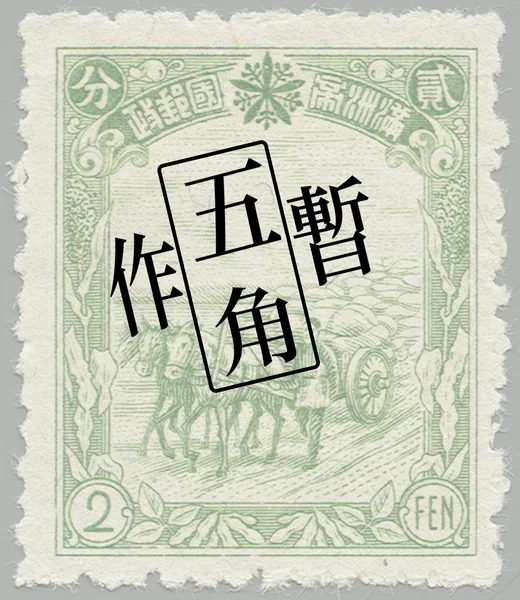
Stamps Overprinted “Temporarily Used as” (2nd Issue)
Issued 7 March 1946. Four-value provisional surcharge set hand-overprinted in black reading Temporarily Used as on Manchukuo 4th edition regular stamps and 3rd and 4th edition regular postal stamps, by the Tonghua Post Office. Some physical examples are believed to exist.
敦化郵區
Dunhua Postal District
Soviet forces occupied Dunhua (敦化) in August 1945 during the Soviet invasion of Manchuria, bringing the Manchukuo administration in the area to an end. In March 1946, Dunhua County was taken over by the Democratic Government and formed part of the Jidong administrative area. On 28 May 1946, following the Nationalist occupation of Jilin City, the CPC Jiliao Provincial Committee (中共吉遼省委), the Jiliao Provincial Government (吉遼省政府) and the Jiliao Military District (吉遼軍區) transferred their headquarters from Jilin to Dunhua.¹
On 13 July 1946, an enlarged meeting of the CPC Jiliao Provincial Committee was convened at Dunhua. Acting upon a decision of the Northeast Bureau, the committee was reorganised as the CPC Jilin Provincial Committee (中共吉林省委). Dunhua consequently remained the temporary seat of the principal provincial Party, government and military organs until 17 August 1946, when they were transferred to Yanji (延吉).¹
Postal and telecommunications services in the Dunhua district survived the political transition in varying degrees. The local gazetteer records that telephone services within Dunhua and the long-distance telephone connection were not interrupted following the liberation of the town in 1945. In March 1946, Dunhua County was formally taken over by the Democratic Government. In December 1946, the existing Post Office (郵政局) and Telegraph-Telephone Office (電報電話局) were merged to form the Dunhua County Postal and Telecommunications Bureau (敦化縣郵電局), organised into Postal, Telecommunications and General Affairs sections and placed under the Yanbian Postal and Telecommunications Administration (延邊郵電管理局).²
From April 1947, the Dunhua County Postal and Telecommunications Bureau operated under the dual authority of the Jilin Provincial Postal and Telecommunications Administration (吉林省郵電管理局) and the county government, with the provincial administration exercising primary control. Nine subordinate postal agencies are recorded at Qinggouzi (青溝子), Heishi (黑石), Weihuling (威虎嶺), Daqiao (大橋), Shaheyan (沙河沿), Guandi (官地), Huangnihe (黃泥河), Qiuligou (秋梨溝) and Dadianzi (大甸子).²
Provisional overprinted stamps bearing the inscription “Northeast Temporarily Used for” (東北暫作) are traditionally attributed to the Dunhua postal district and are recorded used during the spring of 1946. The specialised philatelic literature generally attributes their issue to the Dunhua Post Office, although the available official postal gazetteers do not directly document their production or identify the precise issuing authority. Their attribution should therefore be regarded as philatelically established but not yet confirmed by contemporary administrative records.³
References
¹ Gazetteer of Yanbian Korean Autonomous Prefecture (《延邊朝鮮族自治州志》), Yanbian Korean Autonomous Prefecture Gazetteer Compilation Committee, Zhonghua Book Company, Beijing, 1996, chronology for May–August 1946. Records the transfer of the Jiliao Provincial Committee, Provincial Government and Military District to Dunhua on 28 May 1946, the reorganisation of the provincial Party committee in July, and the transfer of the provincial organs to Yanji on 17 August 1946.
² Jilin Provincial Posts and Telecommunications Gazetteer: Yanbian Volume (《吉林省郵電志·延邊卷》), Yanbian Korean Autonomous Prefecture Posts and Telecommunications Bureau, Beijing Yanshan Publishing House, Beijing, 1997, p. 223. Records the uninterrupted telephone service in 1945, the Democratic Government's takeover in March 1946, the merger of the postal and telecommunications offices in December 1946, the administrative reorganisation in April 1947 and the nine subordinate postal agencies.
³ Northeast China Local Overprints by Communists 1945–1949 on Manchukuo or Japanese Stamps, p. 303. Records the philatelic attribution of the “Northeast Temporarily Used for” provisional issues to the Dunhua Post Office, their use from March to May 1946 and the known denominations and overprint types.
DM3
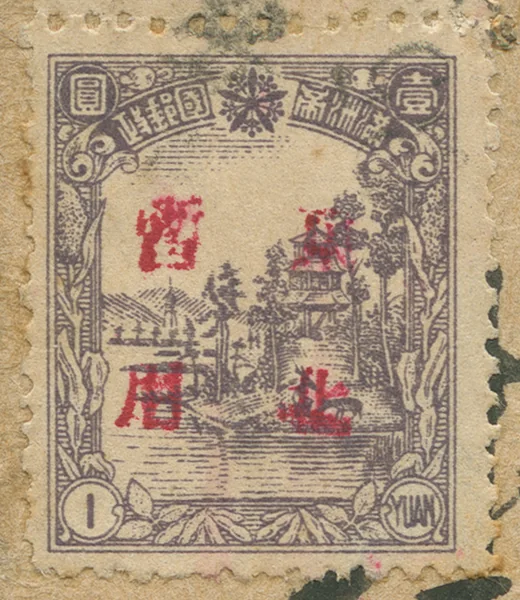
Stamps Overprinted “Northeast Temporarily Used for”
Issued March 1946. Five-value provisional overprint set hand-applied in black, blue-violet, and red using a wooden chop reading Northeast Temporarily Used for on Manchukuo definitives.
DM4
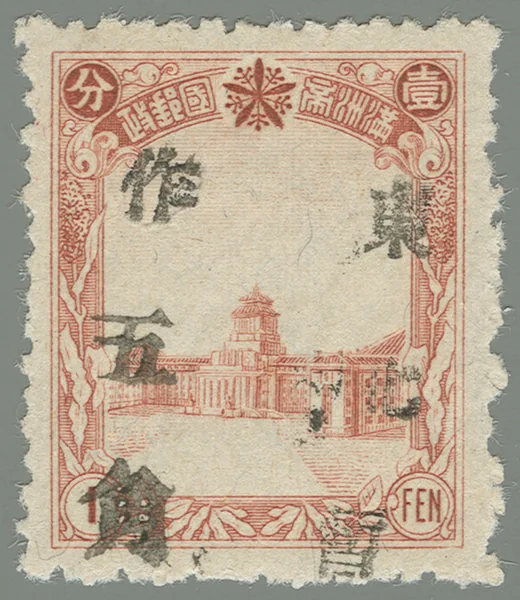
Stamps Overprinted “Northeast Temporarily Used for” and Surcharged
Issued March 1946. Seven-value provisional overprint and surcharge set hand-applied in black on Manchukuo definitives. The $1 / 1c value exists in three overprint types.
延邊分區郵政管理機構
Yanbian Subregion Postal Administration
Following the collapse of Japanese and Manchukuo administration in eastern Manchuria in August 1945, civil and communications services in the Yanbian (延邊) region had to be reorganised under the new Communist authorities. On 20 November 1945, the Yanbian Administrative Commissioner's Office (延邊行政督察專員公署) was established in Yanji (延吉), forming the first regional civil administration under Communist control. On 12 January 1946, the CPC Northeast Bureau established the Jiliao Provincial Committee (吉遼省委), commonly known as the East-Manchuria Sub-Bureau (東滿分局), which exercised political leadership over the wider region.¹
In January 1946, the Jidong Posts and Telecommunications Office (吉東郵電辦事處) was established in Yanji under the leadership of the Yanbian Prefectural Committee and the Administrative Commissioner's Office. The official postal gazetteer records that it initially assumed responsibility for postal and telecommunications affairs in Yanji. Elsewhere in Yanbian, however, communications were gradually restored through the surviving network of former Manchukuo post offices before a unified regional postal administration had been formally established.²
This provisional organisational structure provided the administrative setting in which existing stocks of Manchukuo stamps were adapted for renewed postal use. In March 1946, a regional provisional issue inscribed “Yanbian Subregion – Chinese Postal Service” (「延邊分區 中華郵政」) was introduced. Although no contemporary order identifying the issuing authority has yet been located, the inscription and its geographically dispersed postal use indicate that the stamps were intended for circulation throughout the Yanbian Subregion rather than for use by a single local post office.³
Surviving commercially used examples are recorded with cancellations from Mingyuegou (明月溝) dated 20 March, Tumen Street (圖們街) dated 6 April, Longjing (龍井) dated 8 April, Hunchun (琿春) dated 11 April, Yanji dated 13 April and Tumen (圖們) dated 16 August 1946. At least three further places of use have also been recorded. This distribution provides direct postal evidence that an operational network linked the principal towns of Yanbian several months before the establishment of a formally constituted regional postal and telecommunications administration.³
In September 1946, the Yanbian Postal and Telecommunications Administration (延邊郵電管理局) was formally established. It restored and coordinated postal and telecommunications services in Yanji, Longjing, Tumen, Mingyuegou, Antu (安圖), Helong (和龍) and other offices throughout the region. Existing Post Offices (郵政局) and Telegraph-Telephone Offices (電報電話局) were subsequently combined into unified Postal and Telecommunications Bureaus (郵電局), replacing the decentralised arrangements of the first postwar year with a more integrated regional system.²
On 7 March 1947, the Northeast Posts and Telecommunications General Administration sent Deputy Director Sun Jishu (孫繼書) to take over the Yanbian administration. On 5 April, it was renamed the Jilin Postal and Telecommunications Administration (吉林郵電管理局). This brought the Yanbian postal network under the unified provincial and Northeast postal system.²
References
¹ Gazetteer of Yanbian Korean Autonomous Prefecture (《延邊朝鮮族自治州志》), Yanbian Korean Autonomous Prefecture Gazetteer Compilation Committee, Zhonghua Book Company, Beijing, 1996, regional chronology for November 1945–July 1946. Records the establishment of the Yanbian Administrative Commissioner's Office on 20 November 1945 and the subsequent formation and reorganisation of the Communist regional administrative structure.
² Jilin Provincial Posts and Telecommunications Gazetteer: Yanbian Volume (《吉林省郵電志·延邊卷》), Liu Guangxin (劉廣新), chief editor, compiled by the Yanbian Korean Autonomous Prefecture Posts and Telecommunications Bureau, Beijing Yanshan Publishing House, Beijing, 1997, pp. 12, 223. Records the establishment of the Jidong Posts and Telecommunications Office in Yanji in January 1946, the formation of the Yanbian Postal and Telecommunications Administration in September 1946, the restoration and consolidation of the regional communications network, and its takeover and reorganisation in March–April 1947.
³ Northeast China Local Overprints by Communists 1945–1949 on Manchukuo or Japanese Stamps, section on the “Yanbian Subregion – Chinese Postal Service” issue. Records the provisional issue and the presently known places and dates of postal use, demonstrating its circulation across the wider Yanbian region.
吉林南部至通化郵政通信走廊
Southern Jilin to Tonghua Postal Communications Corridor
Following the collapse of Japanese and Manchukuo authority in August 1945, the restoration of postal communications in southern Jilin (吉林南部) relied heavily on the communications infrastructure inherited from the former administration. An established southern telegraph route connected Jilin (吉林) with Panshi (磐石), Huadian (樺甸), Chaoyang Town (朝陽鎮), Huinan (輝南), Hailong (海龍) and Tonghua (通化). Under Manchukuo, the principal circuit continued from Jilin through Panshi and Huadian to Chaoyang Town and Hailong. This pre-existing route provided the communications axis along which postal and telegraph services could be restored after the Japanese surrender.¹
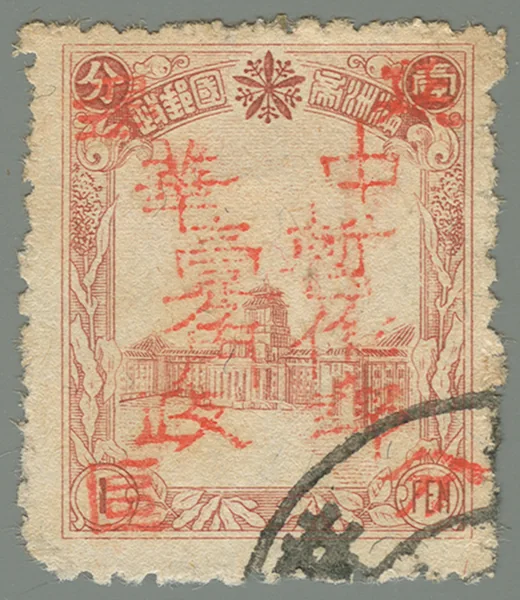
The reconstruction of postal service was placed on a common administrative basis in early 1946. On 7 March 1946, provincial regulations authorised the continued use of available Manchukuo stamps after provisional overprinting with the inscription “Chinese Republic” (中華民國). They also prescribed a simplified revaluation scheme under which denominations below 50 cents were to be surcharged to 50 cents, while denominations of one dollar and above were to be surcharged to two dollars.²
The Jilin Provincial Postal Committee (吉林省郵務委員會) prescribed the general form of the provisional overprints, while the individual post offices engraved and applied their own handstamps locally. The resulting issues therefore display closely related inscriptions and surcharge values, but differ in typography, character spacing, alignment and quality of execution. These variations reflect decentralised local production carried out in accordance with uniform provincial instructions.²
Between March and June 1946, stamps bearing versions of the inscription “Chinese Republic Temporarily Used For” (中華民國暫作) were placed in use at Panshi, Huadian, Badaohezi (八道河子), Chaoyang Town, Hailong and Shanchengzhen (山城鎮). Panshi, Huadian, Chaoyang Town and Hailong lay directly on the established southern communications route, while Badaohezi and Shanchengzhen were connected with the same network through subsidiary routes. Their geographical concentration, closely grouped periods of use and shared overprint formula indicate that these stamps formed a related group of provisional issues associated with the restoration of paid postal service along the southern Jilin to Tonghua communications corridor.²
The issues are nevertheless assigned to the individual post offices that produced and used them. The provincial authorities determined the regulatory framework and general form of the overprints, while the physical handstamps were engraved and applied locally. This combination of provincial direction and local execution explains both the close relationship between the issues and the distinctive characteristics by which the products of the individual post offices can be identified.²
References
¹ Jilin City Gazetteer: Postal and Telecommunications Gazetteer (《吉林市志·郵電志》), Jilin City Local Gazetteer Compilation Committee, Jilin Literature and History Press, Jilin, 1992, p. 163. Records the southern communications route from Jilin through Panshi, Huadian, Chaoyang Town, Huinan and Hailong to Tonghua, together with the Manchukuo-period telegraph circuit linking Jilin, Panshi, Huadian, Chaoyang Town and Hailong.
² History of Philately in Jilin Province (《吉林省集郵史》), Jilin Provincial Philatelic Association, People's Posts and Telecommunications Press, Beijing, 1999, p. 57. Records the provincial postal regulations adopted on 7 March 1946, the prescribed revaluation of available Manchukuo stamps, and the arrangement under which the Jilin Provincial Postal Committee determined the general form of the overprints while individual post offices engraved and applied their own handstamps.
安圖郵政局
Antu Post Office
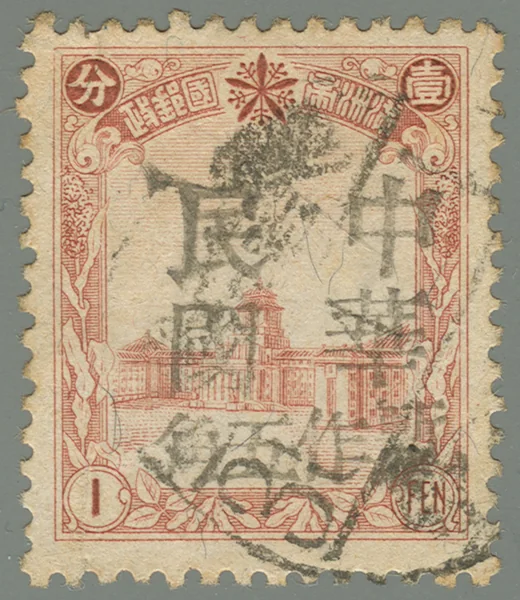
Following the collapse of Japanese and Manchukuo authority in August 1945, postal communications in Antu County (安圖縣) were restored through the local institutions inherited from the former administration. Antu Post Office (安圖郵政局), situated at present-day Songjiang (松江), and Mingyuegou Post Office (明月溝郵政局) both formed part of the county's established postal network.¹
During the first half of 1946, postal and telecommunications services in Antu County had not yet been incorporated into a unified regional administration. Antu Post Office and Mingyuegou Post Office continued to operate as separate postal institutions, alongside Antu Telephone Office (安圖電話局) and Mingyuegou Telegraph and Telephone Office (明月溝電報電話局). The provisional issue used from May to June 1946 therefore belongs to this period of locally administered postal service, before the creation of the Yanbian Postal and Telecommunications Administration (延邊郵電管理局).²
The Yanbian Postal and Telecommunications Administration was established in September 1946 and subsequently restored or reorganised postal and telecommunications services at Antu and Mingyuegou as part of the developing regional network. In the same month, Mingyuegou Post Office and the local telecommunications office were merged to form Mingyuegou Post and Telecommunications Office (明月溝郵電局).³
References
¹ Jilin Postal and Telecommunications Gazetteer: Yanbian Volume (《吉林省郵電志·延邊卷》), Yanbian Korean Autonomous Prefecture Posts and Telecommunications Bureau, Beijing Yanshan Publishing House, Beijing, 1997, pp. 71, 551–552. Records Antu Post Office and Mingyuegou Post Office among the postal institutions operating in Antu County before 1945 and identifies Antu with present-day Songjiang.
² Jilin Postal and Telecommunications Gazetteer: Yanbian Volume (《吉林省郵電志·延邊卷》), Yanbian Korean Autonomous Prefecture Posts and Telecommunications Bureau, Beijing Yanshan Publishing House, Beijing, 1997, pp. 552–553. Records the separate Antu and Mingyuegou postal and telecommunications institutions and shows that they remained administratively distinct until September 1946.
³ Jilin Postal and Telecommunications Gazetteer: Yanbian Volume (《吉林省郵電志·延邊卷》), Yanbian Korean Autonomous Prefecture Posts and Telecommunications Bureau, Beijing Yanshan Publishing House, Beijing, 1997, pp. 7, 73, 551. Records the establishment of the regional administration in September 1946, the restoration of services at Antu and Mingyuegou, and the merger of the Mingyuegou postal and telecommunications offices.
延邊郵電管理局
Yanbian Postal and Telecommunications Administration
Following the collapse of Japanese and Manchukuo authority in August 1945, postal and telecommunications services in Yanbian (延邊) were restored within a rapidly changing civil and political administration. A regional representative conference convened at Yanji (延吉) on 20 November 1945 and formed the Yanbian Administrative Committee. The Yanbian Administrative Commissioner's Office (延邊行政督察專員公署) was formally proclaimed on the following day, with jurisdiction over Yanji, Hunchun (琿春), Helong (和龍), Wangqing (汪清) and Antu (安圖).¹
The first regional postal organisation emerged in January 1946, when the Jidong Posts and Telecommunications Office (吉東郵電辦事處) was established at Yanji. Initially responsible for the postal and telecommunications offices in the city, it provided the organisational basis from which a wider regional network was subsequently developed. During the following months, however, many post offices and telegraph and telephone offices continued to operate as separate local institutions while services were gradually restored throughout Yanbian.²
On 20 September 1946, the Jilin Provincial Government ordered the postal and telephone organisations in the Jidong region to be combined. The new regional administration was formally established on 25 September and assumed responsibility for the principal offices at Yanji, Tumen (圖們), Longjing (龍井), Mingyuegou (明月溝) and Antu, with further offices restored or reorganised shortly afterwards. Contemporary and later sources use both Jidong Postal and Telecommunications Administration (吉東郵電管理局) and Yanbian Postal and Telecommunications Administration (延邊郵電管理局) for this organisation.³
The establishment of the administration marked the transition from a network of separately operated postal and telecommunications offices to a unified regional system. Postal offices and telegraph and telephone offices were progressively merged into combined postal and telecommunications bureaux (郵電局). Services were restored or reorganised at Yanji, Longjing, Tumen, Mingyuegou, Antu, Helong and a number of subsidiary centres, creating a more coherent communications network across the region.²
The regional administration was short-lived. On 7 March 1947, representatives of the Northeast postal authorities arrived in Yanji to assume control of the organisation. On 5 April it was renamed the Jilin Postal and Telecommunications Administration (吉林郵電管理局), bringing the Yanbian network under direct provincial and Northeast postal authority.²
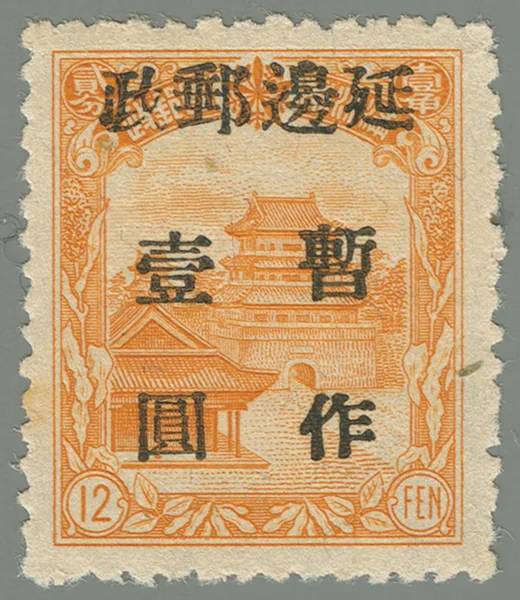
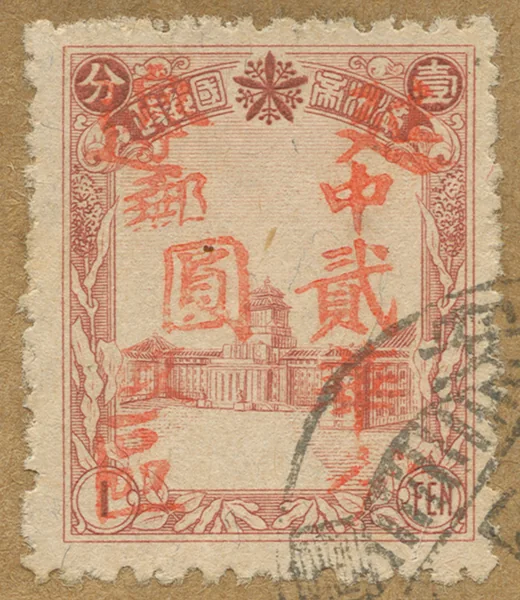
The postal issue directly associated with the new regional administration appeared in October 1946 following the introduction of revised rates effective from 1 October. It consisted of two provisional surcharge stamps produced by machine-overprinting Manchukuo definitive stamps in black movable type with the inscription “Yanbian Post” (延邊郵政), together with “Temporarily Used For” (暫作) and the new denomination. The two values corresponded to the revised rates announced in Yanji on 6 October 1946.⁴
References
¹ Gazetteer of Yanbian Korean Autonomous Prefecture (《延邊朝鮮族自治州志》), Yanbian Korean Autonomous Prefecture Local Gazetteer Compilation Committee, Zhongdi Publishing House, Beijing, 1996, vol. 1, p. 439. Records the formation of the Yanbian Administrative Committee on 20 November 1945 and the formal establishment of the Yanbian Administrative Commissioner's Office on 21 November, together with its original territorial jurisdiction.
² Jilin Postal and Telecommunications Gazetteer: Yanbian Volume (《吉林省郵電志·延邊卷》), Yanbian Korean Autonomous Prefecture Posts and Telecommunications Bureau, Beijing Yanshan Publishing House, Beijing, 1997, pp. 7, 13, 73. Records the establishment of the Jidong Posts and Telecommunications Office in January 1946, the creation of the regional administration in September, the restoration and merger of local offices, and the transfer and renaming of the administration in March and April 1947.
³ A Stamp History of China's Liberated Areas: Northeast Area Volume (《中國解放區郵票史·東北卷》), All-China Philatelic Federation, Anhui Education Publishing House, Hefei, 1995, pp. 45–46. Records the provincial order of 20 September 1946, the formal establishment of the Jidong Postal and Telecommunications Administration on 25 September and its jurisdiction over Yanji, Tumen, Longjing, Mingyuegou and Antu.
⁴ China Stamp Handbook Illustrated: Volume of Liberated Areas (《中國郵票大圖典·解放區卷》), Shandong Provincial Posts and Telecommunications Administration and Shandong Provincial Philatelic Association, People's Posts and Telecommunications Publishing House, Beijing, 1999, p. 67. Records the October 1946 “Yanbian Post Temporarily Used For” issue, its machine-applied movable-type overprint and two listed denominations. The six-value composition adopted in the present catalogue is based on the author's examination of surviving examples and recorded postal material.